Home infusion is not simply a convenience service. Intravenous treatment involves inserting a device into a vein and requires appropriate clinical assessment, infection-control practices, monitoring, and follow-up. In Dubai, the Dubai Health Authority’s current standards for home healthcare specifically include intravenous (IV) therapy within the scope of care that may be provided through home healthcare services for appropriate patients.
The suitability of home treatment depends on the patient’s medical circumstances and the therapy being prescribed. A healthcare professional should determine whether treatment can safely be provided outside a hospital or clinic.
What Is Home IV Infusion?
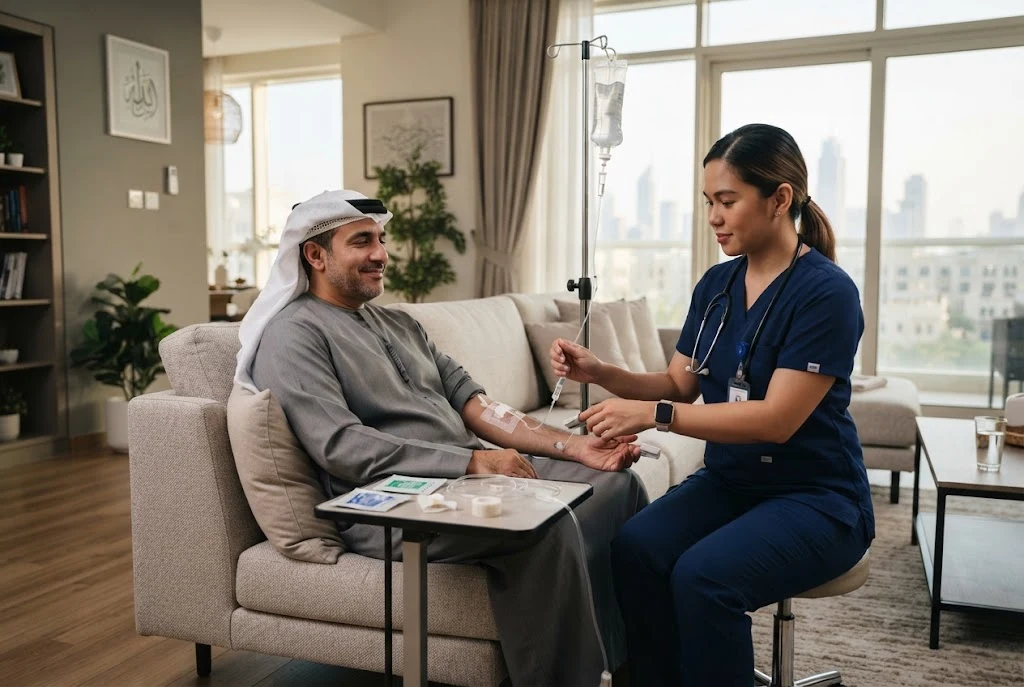
Home IV infusion is the administration of a prescribed substance directly into a vein while the patient remains at home. Depending on the clinical situation, intravenous therapy can involve fluids or medications prescribed for a particular medical need.
The infusion may be delivered through an appropriate intravenous access device selected by the healthcare professional. The exact equipment, medication, duration, and monitoring requirements vary according to the therapy and patient.
Home IV treatment should therefore be viewed as an extension of healthcare delivery rather than a replacement for professional medical assessment.
How Does Home IV Infusion Work?
The process usually begins with a healthcare professional assessing whether home infusion is appropriate. The treatment should have a clinical purpose and be provided by an appropriately licensed healthcare service.
1. Clinical assessment
A healthcare professional reviews the patient’s medical history, current condition, prescribed therapy, allergies, and other relevant factors. The purpose is to establish whether the planned treatment can be delivered safely at home.
2. Treatment planning
If home infusion is considered appropriate, the healthcare team determines the required medication or fluid, route of administration, equipment, monitoring, and follow-up arrangements.
3. Preparation of the infusion
The healthcare professional prepares or verifies the prescribed treatment and the necessary equipment according to applicable clinical procedures.
4. IV access and administration
An appropriately trained healthcare professional establishes or uses suitable intravenous access and administers the prescribed infusion. The patient’s condition may be monitored during the treatment depending on the therapy and clinical circumstances.
5. Completion and follow-up
After the infusion, the healthcare professional assesses the patient as appropriate, manages the IV access according to the treatment plan, and provides follow-up instructions.
DHA’s current home healthcare standards require home healthcare professionals delivering these services to be licensed and registered with DHA in Dubai.
Why Might IV Therapy Be Provided at Home?
For appropriately selected patients, home infusion can reduce the need for repeated travel to a healthcare facility. This may be particularly useful when a prescribed course of IV treatment requires multiple visits and the patient is medically stable enough to receive it at home.
DHA’s standards state that home healthcare is intended for individuals whose health conditions or limitations necessitate in-home care to maintain safety, manage health needs effectively, and support recovery or quality of life without requiring regular visits to healthcare facilities. The standards specifically identify IV therapy among examples of care that may be provided through home healthcare.
Potential practical advantages can include:
- Less travel to a clinic or hospital
- Greater convenience for appropriate patients
- Potentially easier management of repeated treatment appointments
- Care in a familiar home environment
- Support for patients whose health or mobility makes frequent travel difficult
These benefits do not mean that home infusion is appropriate for everyone. Clinical suitability remains the most important consideration.
What Treatments Can Be Given Through Home IV Infusion?
The treatment provided through home infusion depends on the diagnosis, prescription, healthcare provider, and applicable clinical requirements. IV therapy may be used for different medical purposes, but the specific medication or fluid must be determined by an appropriately qualified healthcare professional.
Examples of broad treatment categories can include prescribed intravenous medications and fluids. Some patients may receive a planned course of therapy at home after their healthcare team determines that hospital-based administration is not necessary.
It is important not to assume that every medication, vitamin preparation, supplement, or infusion marketed online is medically appropriate for IV administration. The fact that a substance can be administered intravenously does not by itself establish that it is beneficial or suitable for a particular person.
Home IV Infusion Is Different From Routine Wellness Treatments
Some commercial services market IV infusions for general wellness, hydration, energy, immunity, or other broad benefits. Evidence and clinical appropriateness can vary substantially depending on the specific treatment and the person receiving it.
A medically indicated IV treatment prescribed for a defined clinical need should not be confused with an elective infusion marketed primarily as a wellness product. Patients should ask what the treatment is intended to accomplish, why IV administration is appropriate, what evidence supports it, and what risks apply.
A healthcare professional can help determine whether an infusion is medically appropriate rather than relying solely on promotional claims.
Is Home IV Infusion Safe?
Home IV infusion can be provided safely for appropriately selected patients when the treatment is clinically indicated and delivered through a properly regulated healthcare service. However, intravenous treatment carries risks and requires professional oversight.
Potential complications can include problems at the IV access site, infection, inflammation of the vein, leakage of fluid into surrounding tissue, allergic reactions, medication-related reactions, or other complications depending on the treatment.
The level of risk varies according to the patient’s health, the substance being infused, the method of administration, and the clinical setting. For this reason, a qualified healthcare professional should assess the patient and determine the appropriate monitoring requirements.
Why Professional Monitoring Matters
One important advantage of receiving IV therapy through an appropriate healthcare provider is access to trained professionals who can recognize potential complications and determine when treatment needs to be stopped or escalated.
DHA’s home healthcare standards include requirements relating to licensed professionals, clinical governance, patient and caregiver involvement, and transfer of critical or complicated cases when required.
This is particularly important because a patient’s condition can change during an infusion. Home treatment should therefore have a clear escalation plan when the patient’s needs exceed what can safely be managed at home.
Who May Be Suitable for Home IV Infusion?
Suitability is determined on an individual basis. Home infusion may be considered for some patients who need a prescribed IV therapy but are clinically stable and do not require continuous hospital-level monitoring.
Factors a healthcare team may consider include:
- The patient’s diagnosis and current clinical condition
- The type of IV treatment required
- The expected duration and frequency of treatment
- The patient’s medical history and allergies
- The complexity of the therapy
- The level of monitoring required
- The patient’s home environment and available caregiver support
- The availability of an appropriate healthcare provider
Patients with unstable or rapidly changing conditions may require assessment or treatment in a clinic or hospital instead.
What Should You Ask Before Booking Home IV Infusion?
If you are considering home IV treatment in the UAE, asking questions before the appointment can help clarify whether the service is appropriate and what it includes.
- Is the IV treatment prescribed or clinically indicated?
- Which healthcare professional will administer the infusion?
- Is the provider appropriately licensed for home healthcare?
- What medication or fluid will be administered?
- Why has IV administration been recommended?
- How long is the infusion expected to take?
- What monitoring will be provided?
- What complications should be reported immediately?
- What follow-up care is included?
- What happens if the patient develops a problem during treatment?
- What is the complete cost of the service?
- Does health insurance cover the treatment?
Home IV Infusion Costs in the UAE
There is no single UAE-wide price for home IV infusion. The total cost depends on the treatment, medication or fluid, healthcare provider, professional visit, duration, equipment, location, and any additional services required.
Some providers may advertise a home visit fee separately from the medication or infusion itself. Others may offer packages that combine professional administration with the treatment. Patients should therefore request an itemized price before booking.
Insurance coverage can also vary. A medically prescribed treatment may be subject to different coverage conditions depending on the policy, provider network, authorization requirements, and clinical indication.
Home IV Infusion and Health Insurance
Patients should not assume that every home infusion service is automatically covered by health insurance. Coverage depends on the policy and may differ between medically necessary home healthcare and elective wellness services.
Before treatment, check whether the specific infusion, medication, home healthcare provider, and professional visit are covered. Ask whether prior authorization or a physician’s referral is required.
Coverage may also depend on whether the provider is within the insurer’s approved network. Always confirm the current terms directly with the insurer rather than relying on a general statement about UAE health insurance.
When Home IV Infusion May Not Be Appropriate
Home infusion is not designed for every medical situation. A patient may require hospital or clinic-based care when the condition is unstable, the treatment requires specialized equipment, continuous monitoring is necessary, or complications are likely to require immediate intervention.
Emergency symptoms should never be managed by waiting for a scheduled home infusion appointment. Severe difficulty breathing, loss of consciousness, severe chest pain, major bleeding, signs of a serious allergic reaction, or other potentially life-threatening symptoms require urgent medical attention.
What to Expect After an Infusion
The healthcare professional may provide instructions about monitoring the IV site, activity, medication schedules, hydration, follow-up, and symptoms that should be reported. These instructions depend on the treatment and the patient’s condition.
Patients should contact their healthcare provider if they develop concerning symptoms or unexpected problems after treatment. They should also follow the prescribed treatment schedule rather than changing or repeating an infusion independently.
Choosing a Home IV Infusion Provider in the UAE
When comparing home IV services, focus on clinical standards rather than promotional claims alone. A provider should be able to explain who will administer the treatment, what qualifications or licensing apply, what the treatment involves, and how complications are handled.
In Dubai, DHA’s current home healthcare standards state that home healthcare professionals must be licensed and registered with DHA. The standards also address facility requirements, clinical governance, patient involvement, and procedures for transferring critical or complicated cases when necessary.
For UAE residents considering any home healthcare service, it is sensible to verify the provider’s current licensing and service details with the relevant health authority for the emirate in which care will be delivered.
Final Thoughts on Home IV Infusion
Home IV infusion can provide a practical way for appropriately selected patients to receive prescribed intravenous treatment without making repeated trips to a healthcare facility. However, IV therapy is a medical procedure rather than simply a wellness convenience.
The treatment should be based on an appropriate clinical assessment and delivered by qualified healthcare professionals using suitable procedures and monitoring. Patients should confirm the treatment’s purpose, provider credentials, potential risks, total cost, insurance requirements, and follow-up arrangements before proceeding.
When a patient’s condition is unstable or potentially serious, hospital or emergency care may be more appropriate than treatment at home. A qualified healthcare professional can determine the safest setting based on the individual clinical situation.
