
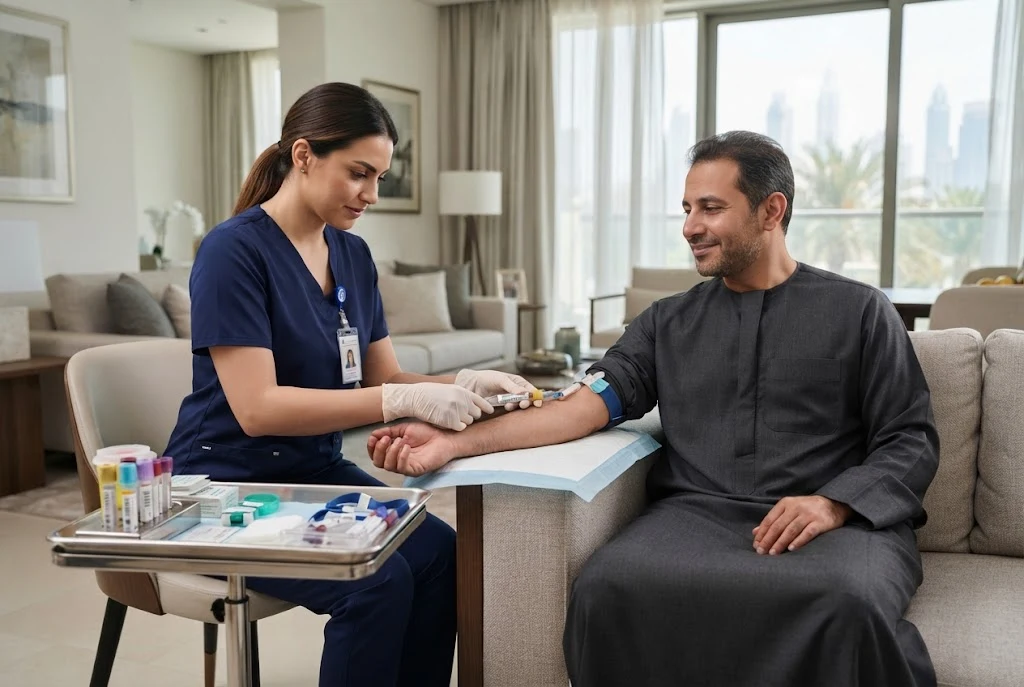
Home sample collection is increasingly available through healthcare providers in the UAE, but the tests offered, collection process, pricing, turnaround time, and eligibility can vary. Dubai Health Authority (DHA) regulates clinical laboratory services and has specific standards covering areas such as sample collection and handling.
What Is a Lab Test at Home?
A lab test at home is a diagnostic testing service in which a healthcare professional collects a patient’s specimen at their residence instead of requiring the patient to visit a laboratory for collection.
Depending on the requested test, the specimen may include blood, urine, or another appropriate sample. The collected specimen is then handled according to applicable laboratory procedures and transported for analysis.
Home testing does not necessarily mean that the test itself is performed inside the patient’s home. In many cases, the home visit is primarily for professional sample collection, while the actual analysis takes place in a clinical laboratory.
For broader healthcare information relevant to people living in the Emirates, you can also explore UAE Health Line.
Which Tests Can Be Done at Home?
The availability of home sample collection depends on the healthcare provider, laboratory, test requirements, and the patient’s circumstances. Common categories that may be offered through home collection services can include routine blood investigations and selected urine or other specimen-based tests.
Examples may include:
- Routine blood tests
- Complete blood count testing
- Blood glucose testing
- Cholesterol and lipid testing
- Kidney and liver function investigations
- Selected vitamin and nutrient tests
- Hormone-related laboratory tests
- Urine testing
- Selected infection-related tests
- Other laboratory investigations requested by a healthcare professional
This does not mean that every provider offers all of these tests as a home service. Some investigations require specific collection conditions, specialized equipment, timed samples, imaging, or clinical supervision and therefore may need to be performed at a healthcare facility.
How Does Lab Test at Home Service Work?
The process can differ between providers, but a typical home collection service follows several steps.
1. Select the required test
You may receive a test request from a doctor or discuss your testing needs with a healthcare provider. Before booking, confirm exactly which test is required because similar-sounding tests can have different preparation and specimen requirements.
2. Schedule home collection
The provider collects your address, contact information, preferred appointment time, and details about the requested test. Some services may offer scheduled appointments, while availability can depend on the location and collection team.
3. Prepare according to instructions
Some tests require fasting or other preparation, while others do not. Do not assume that fasting is required for every blood test. Follow the instructions supplied by the healthcare professional or laboratory for the specific investigation.
4. A healthcare professional collects the sample
A trained professional visits the home and collects the appropriate specimen using the required collection procedure. The professional may verify patient details and test requirements before collection.
5. The sample is transported to the laboratory
Specimens need appropriate identification, handling, storage, and transportation. DHA’s clinical laboratory standards include requirements relating to sample collection sites and specimen handling, which highlights why professional collection and appropriate laboratory procedures matter.
6. The laboratory processes the specimen
The sample is analyzed by the relevant laboratory. Results may then be delivered through an online portal, app, email, printed report, or another method offered by the provider.
Benefits of Lab Test at Home
Home sample collection can offer several practical advantages without changing the basic purpose of laboratory testing.
Convenience
The biggest advantage is that patients do not always need to travel to a laboratory for specimen collection. This can be useful for people with demanding schedules or limited mobility.
Useful for families
Parents managing several healthcare appointments may find home collection more convenient, particularly when multiple family members require testing. However, children’s testing should always follow age-appropriate clinical guidance.
Helpful for older adults
Older adults or people who have difficulty travelling may benefit from having appropriate samples collected at home when the service is clinically suitable.
Reduced travel
Home collection eliminates the need for a separate journey to a laboratory, which can be especially convenient when a patient is recovering at home or has mobility limitations.
Potentially easier scheduling
Depending on the provider, patients may be able to select a home collection appointment that fits their schedule instead of arranging transportation to a laboratory.
How Much Does a Lab Test at Home Cost in the UAE?
There is no single UAE-wide price for a lab test at home. The final cost can depend on the individual test, number of tests, laboratory, home collection fee, location, appointment timing, and whether the service is covered by insurance.
Some providers advertise individual tests, while others offer packages containing multiple investigations. A package price should not automatically be assumed to be the cost of an individual diagnostic test.
Before booking, ask for a clear breakdown of:
- The laboratory test price
- Home sample collection charges
- Any consultation or medical-review fee
- Additional specimen or handling charges
- Urgent or express processing charges, if available
- Applicable taxes or other fees
Prices can change, so current provider pricing should be confirmed directly before arranging the service.
Does Insurance Cover Lab Tests at Home?
Insurance coverage depends on the individual policy and insurer. A laboratory test that is covered when ordered and performed through an approved healthcare network is not necessarily covered in exactly the same way when home collection is requested.
Before booking, check whether the test itself is covered, whether the laboratory is within your insurer’s network, whether a physician’s request is required, and whether the home collection component is reimbursable.
Coverage may also depend on the reason for testing, the policy’s benefits, prior authorization requirements, and the specific provider.
Do You Need a Doctor’s Request for a Lab Test at Home?
The answer can depend on the test and applicable healthcare requirements. Some laboratory investigations may require a request from a licensed physician, while providers may offer certain permitted services under different arrangements.
DHA’s clinical laboratory inspection guidance states that clinical laboratory tests are to be performed upon a request from a DHA-licensed physician, subject to the applicable standards and requirements.
For this reason, patients should not assume that every laboratory test can simply be ordered independently. If you are unsure which test is appropriate, discussing the symptoms or health concern with a qualified healthcare professional can help determine what evaluation is actually needed.
How to Prepare for a Home Blood Test
Preparation depends on the specific investigation. If fasting is required, the laboratory or healthcare professional should explain the fasting period and any instructions concerning food, drinks, medications, or supplements.
Before the appointment:
- Confirm the exact tests being collected.
- Ask whether fasting is required.
- Follow any instructions supplied by the laboratory.
- Keep relevant medical documents available if requested.
- Tell the healthcare professional about relevant medications or medical conditions when appropriate.
- Make sure the collector can safely access the patient and perform the collection.
Do not stop prescribed medication simply because you are having a blood test unless a qualified healthcare professional has specifically instructed you to do so.
How Long Does Home Lab Testing Take?
There are two separate timeframes to consider: the home collection appointment and the laboratory result turnaround time.
The sample collection itself may be relatively brief, but the total time before results are available depends on the type of test, laboratory processing requirements, specimen transportation, and whether the patient has selected a standard or expedited service.
Some routine investigations may have relatively short turnaround times, while specialized tests can take longer. Always ask the provider for the expected timeframe for the specific test rather than relying on a general estimate.
How Are Lab Test Results Delivered?
Different providers use different methods for delivering laboratory reports. Depending on the service, results may be accessible through an online portal, mobile application, email, or another secure reporting method.
Ask how and when your results will be delivered before booking. You should also ask who will explain the results if the test was ordered because of symptoms or an ongoing medical concern.
A laboratory report should not be interpreted in isolation. A result outside a reference range does not automatically establish a diagnosis, and a result within a reference range does not necessarily rule out every health problem. Interpretation depends on the test, clinical history, symptoms, and other relevant findings.
What to Check Before Booking a Home Lab Service
Because home collection involves both healthcare personnel and laboratory processing, choosing the service should involve more than comparing prices.
Consider asking:
- Is the healthcare provider appropriately licensed?
- Which laboratory will process the specimen?
- Who will collect the sample?
- Does the provider offer the exact test you need?
- Is a physician’s request required?
- What preparation is required?
- What is the complete price, including home collection?
- How will the specimen be transported?
- What is the expected result turnaround time?
- How will the report be delivered?
- Is the service covered by your health insurance?
- How can you contact the provider if there is a problem with the sample or report?
When Home Testing May Not Be Appropriate
Home sample collection is designed for suitable diagnostic testing situations, not as a replacement for urgent medical evaluation.
If someone has severe symptoms, rapidly worsening illness, significant breathing difficulty, loss of consciousness, severe chest pain, major bleeding, or another potentially serious emergency, arranging a routine home laboratory appointment should not delay urgent medical care.
Similarly, a laboratory test should not be used as a substitute for a clinical assessment when symptoms require examination by a healthcare professional. The appropriate test depends on the patient’s circumstances, and unnecessary testing can sometimes create confusing or incidental results.
Lab Test at Home vs. Visiting a Laboratory
The main difference is generally where the specimen is collected. With a traditional laboratory visit, the patient travels to the collection facility. With home testing, an appropriate healthcare professional comes to the patient’s residence when the service is available.
The actual laboratory analysis may still take place at a clinical laboratory. Therefore, home collection is primarily a convenience and accessibility option rather than a completely different form of laboratory science.
Final Considerations Before Booking
A lab test at home can make diagnostic sample collection more convenient for patients across the UAE. It may be particularly useful for people who have difficulty travelling, families managing multiple appointments, older adults, and patients whose healthcare professional has requested suitable laboratory investigations.
However, the availability of home collection, test requirements, costs, insurance coverage, and result turnaround times vary between providers. Confirm these details before booking, and use appropriately licensed healthcare and laboratory services.
Most importantly, choose testing based on a genuine healthcare need rather than ordering investigations simply because they are convenient. When symptoms are concerning or unclear, a qualified healthcare professional can help determine whether laboratory testing is appropriate and which investigation is relevant.
